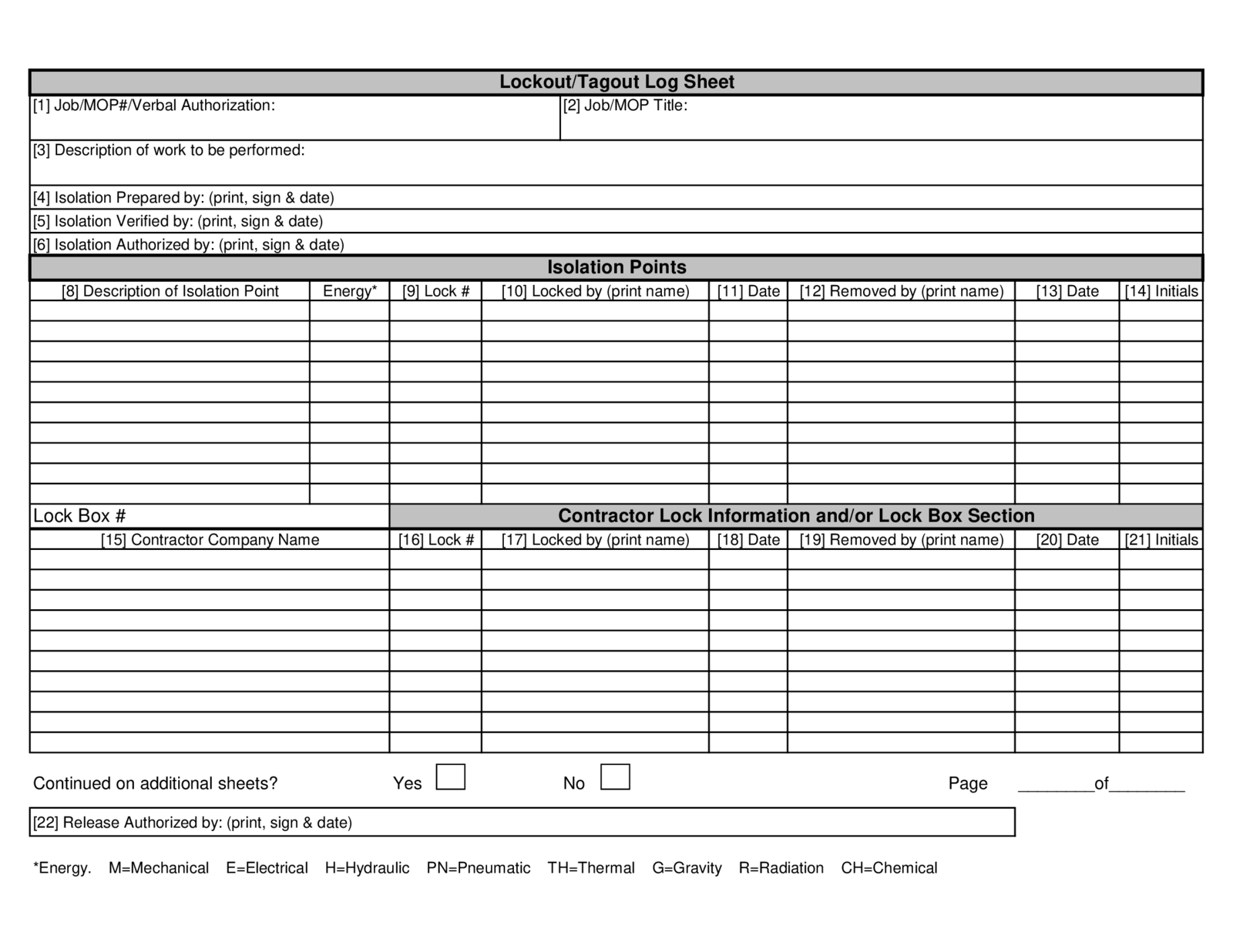
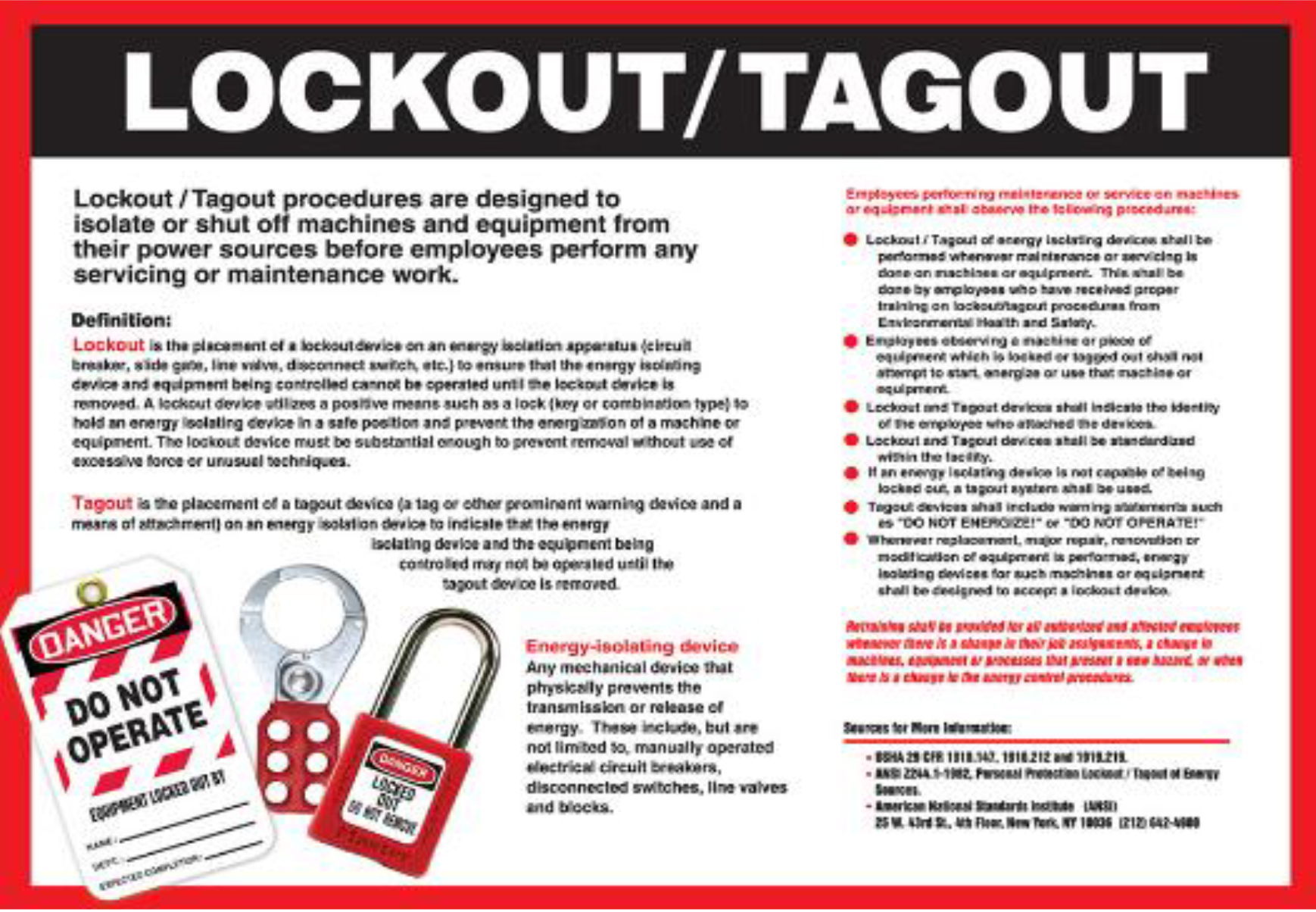
Machines don’t fail safely. When maintenance or servicing begins without isolating hazardous energy, the result is often injury—or worse. Standard lockout tagout (LOTO) checklists aren’t enough. A one-size-fits-all approach fails when applied to complex, high-risk machinery like hydraulic presses, conveyor systems, or industrial mixers. That’s where equipment specific lockout tagout procedures become non-negotiable.
These procedures go beyond general rules. They map every energy source, define precise shutdown sequences, and identify exact isolation points for individual machines. Without them, workers rely on memory and assumption—two of the weakest links in safety systems.
Why General LOTO Isn’t Enough
OSHA’s standard 29 CFR 1910.147 requires employers to establish a written energy control program. But compliance isn’t just about having a procedure—it’s about having the right procedure.
A blanket LOTO policy may instruct workers to “isolate all energy sources” and “apply lockout devices.” But what if the equipment has: - Residual pressure in pneumatic lines? - Stored energy in springs or flywheels? - Multiple power inputs (electrical, hydraulic, gravity-fed)?
Generic steps won’t answer those questions. Equipment specific procedures do.
Consider a facility where a worker serviced a metal shear without realizing a hydraulic accumulator could release stored energy even after power was cut. The result: a crushed hand. The root cause? A generic LOTO form that didn’t mention the accumulator.
Equipment specific procedures eliminate ambiguity by addressing the unique risks of each machine.
What Defines an Equipment Specific LOTO Procedure
An effective, equipment specific lockout tagout procedure contains five non-negotiable elements:
1. Machine Identification Exactly which piece of equipment is covered? Use:
- Asset number
- Location (e.g., Production Line 3, Station B)
- Manufacturer and model
Ambiguity kills. “Conveyor system” isn’t enough. “Conveyor 7A – Buhler Grain Transfer System, Model GTC-2200” is.
2. Energy Source Inventory List every potential energy source:
- Electrical (main disconnect, control circuits)
- Hydraulic (pumps, accumulators)
- Pneumatic (compressed air lines, reservoirs)
- Mechanical (springs, gravity-fed chutes)
- Chemical (pressurized tanks)
- Thermal (heated rollers, steam lines)
Example: A CNC lathe may have electrical power, hydraulic clamping systems, and pneumatic tool changers—all requiring isolation.
3. Step-by-Step Shutdown Sequence
- This isn’t guesswork. It’s a chronological script:
- Notify affected personnel
- Shut down via normal stop button
- Open main disconnect switch
- Depressurize hydraulic lines via bleed valve
- Block moving parts (e.g., place lockout on tailstock)
Each step must reflect how the machine actually behaves—not how it should behave.
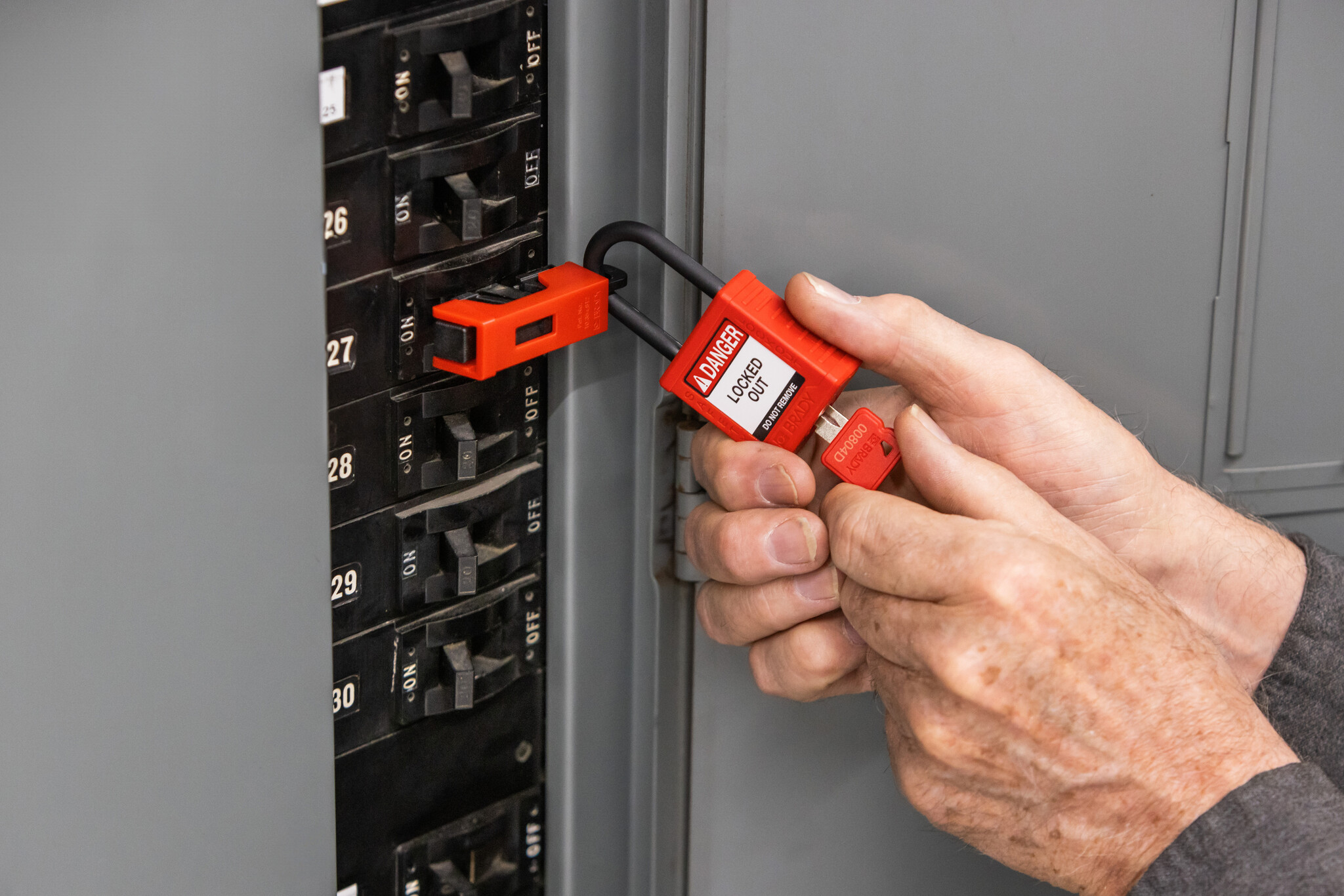
4. Isolation and Lockout Points Pinpoint exactly where locks and tags go:

- Electrical panel: Disconnect switch #4
- Hydraulic line: Isolation valve near pump manifold
- Pneumatic: Ball valve on supply line at junction J-12
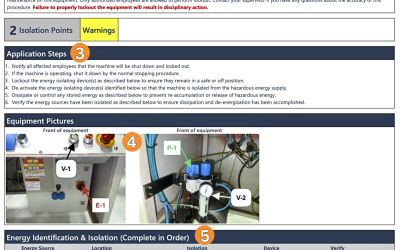
Attach diagrams or photos if needed. A photo of the isolation point with a red arrow and label raises clarity 10x.
5. Verification of Zero Energy The most overlooked step. Workers must prove the machine is safe: - Try to start the machine (after ensuring no one is in the danger zone) - Use a voltage tester on circuits - Monitor pressure gauges until they read zero
If the machine can still move, hum, or pressurize—LOTO failed.
Real-World Examples by Equipment Type
Industrial Mixer (Food Processing) Hazards: Rotating blades, gravity-fed ingredient hoppers, hydraulic lift system Procedure Highlights: - Lockout main motor disconnect (Panel Q3, Breaker 7) - Close and lock isolation valve on hydraulic lift line - Block hopper with steel bar to prevent gravity feed - Test: Attempt startup; verify blades do not rotate
Common mistake: Workers lock only the motor, ignoring the hydraulic system. The lift can still lower unexpectedly.
Hydraulic Press (Metal Stamping) Hazards: High-pressure fluid, uncontrolled ram descent, trapped energy Procedure Highlights: - Power down via E-stop - Isolate main electrical disconnect (Cabinet 12B) - Release pressure from accumulators using manual bleed valve - Engage mechanical hold-up device - Test: Activate control circuit; confirm ram does not move
Limitation: Some older presses lack bleed valves. In these cases, procedures must include extended wait times (e.g., 15 minutes) to dissipate pressure.
Conveyor System (Distribution Center) Hazards: Multiple drive points, gravity zones, automated transfers Procedure Highlights: - Shut down via local disconnect at Drive Motor 3 - Lock out main control panel relay (Circuit 4A) - Block rollers at incline section with chocks - Tag all downstream transfer points
Workflow tip: Use numbered locks if multiple workers are involved. Each technician applies their own lock, and the machine stays locked until all are removed.
Building Your Equipment Specific Procedures: A Practical Framework
Creating these procedures isn’t paperwork—it’s engineering. Follow this workflow:
Step 1: Conduct a Machine Risk Assessment Walk through each machine with maintenance techs and operators. Ask: - Where does energy enter? - What moves during operation? - What could go wrong during service?
Document findings with photos and diagrams.
Step 2: Map Energy Isolation Points Physically locate every disconnect, valve, or block point. Label them with permanent tags (e.g., “LOTO POINT – ELECTRICAL DISCONNECT”).
Step 3: Draft the Procedure Use a standard template but customize every line. Avoid vague terms like “secure the system.” Use “Close and lock ball valve HV-2 on hydraulic return line.”

Step 4: Test Under Supervision Have an experienced technician perform the LOTO using the draft procedure. Time it. Note confusion points. Adjust.
Step 5: Train and Certify Workers must be trained on each specific machine they’ll service. Keep records. Re-train annually or when procedures change.
Common Pitfalls (And How to Avoid Them)
Pitfall 1: Copy-Paste Procedures Some facilities copy LOTO steps from one machine to another “similar” one. But even two identical lathes may have different hydraulic setups due to field modifications.
Fix: Audit each machine individually. No exceptions.
Pitfall 2: Overlooking Stored Energy A saw blade coasts for 45 seconds after power-off. If you don’t wait, it’s still hazardous.
Fix: Include “Wait Time” steps: “Wait 60 seconds for rotational energy to dissipate.”
Pitfall 3: Skipping Verification Locks are applied, tags are in place—but no one tests. The machine still has residual voltage or pressure.
Fix: Make verification mandatory. Add: “Test operation using start controls. Confirm zero movement.”
Pitfall 4: Poor Accessibility LOTO points buried under panels or behind guards slow response and invite shortcuts.
Fix: Redesign access. Install external lockout valves or disconnects where feasible.
Tools and Resources for Effective Implementation
While LOTO is a process, not a product, certain tools make equipment specific procedures easier to manage and enforce.
| Tool | Purpose | Real-World Use Case |
|---|---|---|
| LOTO Management Software (e.g., ProFinda, Safeteka) | Digital procedure access, lock tracking, training logs | Technician scans QR code on machine to pull up LOTO steps on tablet |
| Lockout Kits (e.g., Brady, Grainger) | Group lockout stations, hasps, lockout tags | Multi-craft team uses one breaker; each applies personal lock |
| Energy Isolation Diagrams | Visual maps of energy paths | Poster mounted near machine shows 5 isolation points |
| Smart Lockout Devices | Bluetooth-enabled locks with audit trails | Supervisor gets alert if lock is removed prematurely |
| Mobile Training Apps | On-demand LOTO training videos | New hire watches 3-minute demo on servicing a packaging machine |
Choose tools that integrate with your existing safety ecosystem—not replace judgment.
The Bottom Line: Specificity Saves Lives
Equipment specific lockout tagout procedures aren’t regulatory box-ticking. They’re survival tools. A general LOTO plan treats all machines the same. A specific one respects their differences.
When a worker faces a 500-ton press or a high-speed packaging line, they don’t need theory. They need a clear, tested, machine-by-machine roadmap to safety.
Start with your highest-risk equipment. Build procedures that answer every “what if.” Train until execution is muscle memory.
Because the next life saved won’t be from a policy buried in a binder—it’ll be from a specific step followed on a specific machine, at the right moment.
Frequently Asked Questions
What makes a LOTO procedure "equipment specific"? It details the exact shutdown sequence, isolation points, energy sources, and verification steps for one particular machine—not a class of machines.
Do I need a separate procedure for each machine? Yes, if they have different energy sources or configurations. Two identical CNC mills from the same manufacturer might share a procedure—but only after verification.
Who should write equipment specific LOTO procedures? A team including safety officers, maintenance supervisors, and experienced technicians familiar with the machine.
Can equipment specific procedures be digital? Yes. Many companies use tablets or QR codes at machines to access digital versions, provided they’re always available and legible.
How often should these procedures be reviewed? Annually, or whenever the machine is modified, relocated, or involved in a near-miss.
Are diagrams required in equipment specific LOTO? Not by OSHA, but highly recommended. Photos or schematics of isolation points drastically improve accuracy.
What’s the biggest mistake during implementation? Assuming one procedure fits multiple machines. Even small differences in setup can create deadly gaps in protection.
FAQ
What should you look for in Equipment Specific Lockout Tagout Procedures That Work? Focus on relevance, practical value, and how well the solution matches real user intent.
Is Equipment Specific Lockout Tagout Procedures That Work suitable for beginners? That depends on the workflow, but a clear step-by-step approach usually makes it easier to start.
How do you compare options around Equipment Specific Lockout Tagout Procedures That Work? Compare features, trust signals, limitations, pricing, and ease of implementation.
What mistakes should you avoid? Avoid generic choices, weak validation, and decisions based only on marketing claims.
What is the next best step? Shortlist the most relevant options, validate them quickly, and refine from real-world results.